
Available now

Built to Last

The Marriage Field Guide

26 Tips to Keep Your Marriage Strong

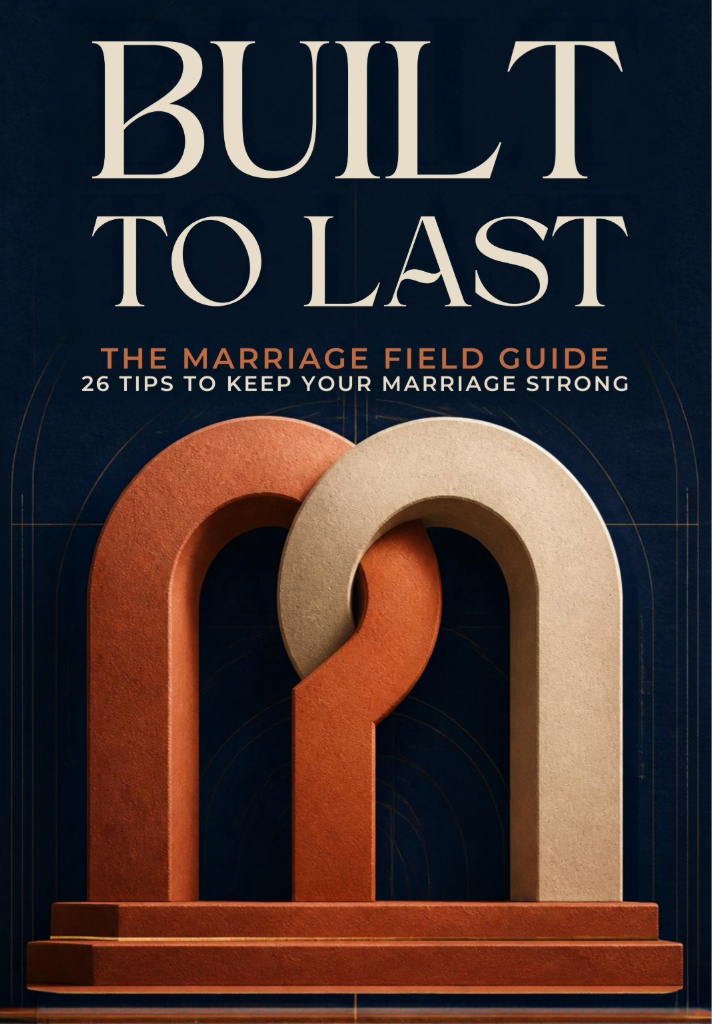
Built to Last: The Marriage Field Guide book cover, with two interlocking arches on a navy background

More than good intentions

A practical guide for building a stronger marriage.

Each tip explains why it matters, gives you something worth discussing, and ends with a concrete step to practice together. Use it before marriage, with your spouse, or with a group—then put the pages to work.

We read the books, fought the fights, and made the mistakes—so you don’t have to.

Quincy and Keralene Mims smiling together

Meet the authors

Quincy and Keralene Mims

Quincy and Keralene lead a marriage group in the Fort Worth area. Drawing from their own mistakes, lessons, and faith, they wrote the practical guide they wish they’d had earlier.

Built from honest conversations and tested with their marriage group, Built to Last gives couples practical ways to turn what they learn into something they do together.

An AI perspective · Grok manuscript evaluation

“Most marriage books deliver principles or inspiration; this one repeatedly forces decisions, conversation, and immediate practice.”

— Grok, evaluating the submitted manuscript

We submitted the complete manuscript to Grok for evaluation without telling it we were the authors or providing personal background. Selected excerpts from its AI-generated assessment appear here.

  • “The tone is direct without being harsh.”
  • “Occasional dry, self-aware humor keeps the material from becoming preachy or heavy.”
  • “It is short, ordered by practical priority, and engineered for repeated use.”
Read the evaluation’s qualifications

The assessment also noted that the Christian framing is integral, that both partners’ willingness to engage matters, and that results depend on consistent application. It identified clinical complexity as outside the guide’s full scope and emphasized that no set of practices can eliminate every pathway to divorce.

These excerpts are from an AI-generated manuscript evaluation. They represent Grok’s assessment, not an endorsement by xAI or a reader testimonial.

Read a complete tip

Gratitude Over Comparison

Every tip explains the principle—and then gives you something concrete to do with it. Here is Tip 16 exactly as it appears in Built to Last.

Tip 16 of 26

Gratitude Over Comparison

Nobody is perfect. That’s an immutable fact of life.

Familiarity has a way of making your spouse’s faults easier to notice and their sacrifices easier to overlook. The things that once impressed you gradually become things you simply expect.

Keralene always notices the stray hairs I miss on my neck—usually while I’m driving and she’s examining me from the passenger seat.

“NO ONE WILL EVER SEE THOSE!” I tell her.

She sees them. Every time.

First Thessalonians 5:18 says, “In everything give thanks, for this is God’s will for you in Christ Jesus.”

Notice that it says in everything—not for every wrong. Gratitude doesn’t pretend problems don’t exist. It simply chooses the higher road.

Research supports the power of appreciation. Researchers found that feeling appreciated—and being appreciative—encouraged behaviors that help maintain intimate relationships. Another study found that gratitude was associated with stronger feelings of connection.

Gratitude changes what you notice. But so does comparison.

Social media gives us unlimited opportunities to compare our ordinary lives with somebody else’s carefully edited highlight reel. Their vacation. Their house. Their anniversary post. Their spouse who apparently cooks dinner, earns six figures, maintains visible abdominal muscles, and never does anything wrong.

Comparison takes the strongest quality you see in someone else and compares it with the weakest quality you see in your spouse. That contest was rigged from the beginning.

Stop doing it.

Contentment doesn’t mean settling for neglect or mistreatment. It means refusing to view your spouse as a defective version of somebody else.

Thank your spouse for what has become routine. Notice the work nobody applauds. Compliment the qualities familiarity has taught you to take for granted.

What you repeatedly feed will grow.

Feed gratitude. Starve comparison.

The grass isn’t always greener on the other side.

Half the time, it’s astroturf.

Put It Into Practice

Change What You Notice

Gratitude becomes powerful when your spouse can actually hear it.

  1. Be specific. Replace a generic “Thanks” with exactly what your spouse did and why it mattered.
  2. Notice the ordinary. Acknowledge the routine work—meals, errands, cleaning, planning, providing—that usually receives no applause.
  3. Interrupt comparison. Identify the person, account, or situation that makes you dissatisfied with your spouse or marriage. Stop feeding it.
  4. Replace complaints with appreciation. Before criticizing something your spouse lacks, name something valuable they consistently bring to the marriage.

Our Gratitude Plan

Something my spouse does that I overlook:

A quality I never want to take for granted:

One source of comparison I need to limit:

Talk About It

  • When do you feel most appreciated by me?
  • Has comparison caused either of us to undervalue what we have?

This Week

For five days, thank your spouse for one specific thing each day and explain why it mattered. No repeats—and “Thanks for being you” doesn’t count.

Reflection QuestionAm I more focused on what my spouse lacks—or on the blessings they bring?